



What’s the Problem?
Under current practice, removing a permanent resin joint means cutting it out and jointing in a new cable section. A temporary LV joint should instead be removable without cutting back or re-stripping cables, avoiding extra excavation or roadworks. This would allow faster fault restoration and let cables be pot-ended and left safely while other works continue.
As the joint may remain in an open excavation bay, it must provide mechanical and water ingress protection. Barriers and signage will secure the area, but the joint itself should only be accessible to authorised personnel and not removable by the public.
SP Energy Networks (SPEN) staff normal working practices involve leaving temporary joints, to work on other parts of the affected feeder and then return to access the temporary joint, promptly installing a permanent joint before reinstatement. While this method leaves stripped cables intact, when the temporary joint is removed, future methods for LV temporary jointing should offer an equivalent or greater degree of tamper resistance and mechanical protection, as a permanent joint, while being easily removable by authorised staff.
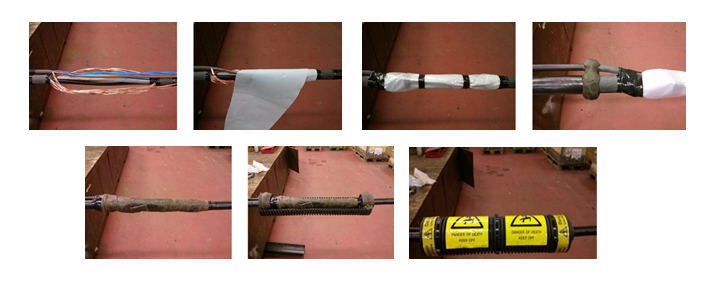
Preferred Output
SPEN is seeking an LV temporary jointing solution that:
- Can be installed and removed efficiently and safely
- Is only able to be removed by authorised personnel
- Can be removed without damaging the stripped cable ends to allow the temporary joint to be swapped out for a permanent resin joint quickly
- Can be left unsupervised in an excavated joint bay safely for up to 72 hours
- Fully adheres to technical standards and ESQCR regulations.
The key requirements are:
- Function for multiple cable sizes (0.1cu, 0.2cu, 95wf, 185wf, up to 300mm2)
- Function across 3 and 4 core cables
- Pass a short circuit test and be able to withstand fault currents
- Provide mechanical protection
- Prevent water ingress
- Meet ESQCR Regulations
- Meet international standards, British standards, ISO Standards, ENA standards and legislation as outlined in the national standards scope attached
- Meet occupational hygiene guidelines, as in ISO 45001
- Meet sustainability guidelines, as in ISO 14001.
Deadline
The deadline for this opportunity is 8 December 2025. Please submit your proposal above.