


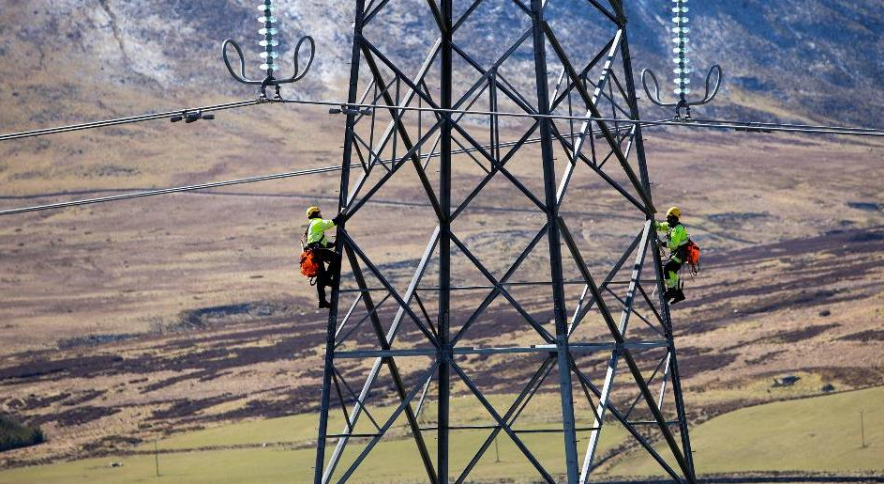
We are supporting our partners SSEN Transmission as part of the 2026 Energy Innovation Basecamp.
Innovative people and businesses are invited by the Energy Networks Association (ENA) to propose ideas and solutions to solve problems suggested by Britain’s electricity and gas networks.
If you would like our support in submitting your application, please contact us.
Please note the deadline for this opportunity is 13 March 2026.
What’s the Problem?
Access to overhead line towers is often slow and costly, creating significant challenges for both routine maintenance and rapid response activities.
- Current access is limited: while some towers have vehicle access, teams often need to walk 2–3 spans to reach them. When there is emergency situation with personnel injury or in customers off supply, then safe access and egress is critical
- Emergency response plans are slowed down due to poor accessibility, increasing safety risks and operational delays
- Permanent access solutions are rarely implemented during planning stages because of cost and environmental objections.
As networks expand and climate-driven events increase in frequency, the limitations of current access methods are becoming more acute and costly. Permanent access solutions are rarely implemented during planning stages because of cost and project objectives.
What’s Required?
We are seeking innovative, practical solutions that enable faster, safer, and more reliable access to overhead line towers across a variety of environments. Solutions should reduce the need for personnel to physically traverse difficult terrain for the last span to reach towers. These can include new access methods, tools, infrastructure, or operational techniques, and should ideally target mid-to-high Technology Readiness Levels (TRL 6-9) with evidence of prior testing or feasibility. Proposals must be capable of scaling across extensive transmission networks and adaptable to different terrain types, such as rocky mountainous terrain, peat bogs, fields or river crossings, improving safety and efficiency. Solutions should either:
- Improve physical access (eg novel mobility platforms, modular pathways, rapid-deployment access aids)
- Enhance remote or alternative access (eg drones, robotic systems, hybrid inspection approaches)
We welcome both standalone technologies and integrated methods that reduce dependency on helicopters and on-foot travel.
What are the Constraints?
Solutions must comply to ENA standards ENATS 43-8 for OHL clearance and adhere to environmental requirements relevant to transmission assets and land access. They should integrate with existing operational procedures and be deployable without major system downtime. Remote monitoring can be carried out but maintenance needs to be generally done by OHL personnel (working at heights up to 70 meters).
Cost-effectiveness is key, with strong consideration for repeatable deployment and long-term maintenance affordability. Proposals must accommodate varied terrain, weather conditions, and accessibility restrictions, and should not require large permanent infrastructure unless justified by value. Any data-driven solutions must be compatible with existing digital systems and security protocols.
Who are the Key Players
Key stakeholders include transmission network owners, asset management, operations teams, landowners, and system planners. SSEN Transmission Operation and safety team.
Does the Problem Build on Existing or Previous Projects?
This challenge builds on ongoing efforts to improve transmission network resilience, including remote condition monitoring, autonomous inspections, and digital modelling of the network. No previous innovation projects known, but this problem is industry wide issue.